
Durable Flatwork Built for Long-Term Performance
Licensed Concrete Services in San Diego for residential and commercial properties requiring foundations, driveways, patios, and decorative flatwork installations
Concrete work creates permanent surfaces and structural foundations that handle compressive loads, vehicle traffic, and decades of weather exposure without requiring replacement when properly installed. Driveways crack when subgrade isn't compacted uniformly or when inadequate thickness can't handle vehicle weights; walkways settle and create trip hazards when soil preparation skips moisture conditioning or when control joints don't account for thermal expansion; foundation slabs fail when reinforcement is positioned incorrectly or concrete mix doesn't meet strength specifications. Trueskil provides licensed concrete services across San Diego that address site preparation, proper forming, steel reinforcement placement, concrete placement and finishing, and curing processes that determine long-term durability.
Concrete installation begins with excavation and grading to establish proper drainage away from structures and uniform subgrade elevation. Base material gets compacted in lifts using mechanical tampers to prevent later settlement, forms are built to precise dimensions with bracing that prevents movement during concrete placement, and reinforcement steel or welded wire mesh is positioned at the correct depth within the slab thickness. Concrete mix design specifies compressive strength based on application—higher PSI ratings for driveways and structural slabs, standard mixes for walkways and patios—and placement timing coordinates with temperature conditions since extreme heat or cold affects curing chemistry.
Request a site evaluation to assess your property's grading, discuss concrete applications, and receive a detailed project estimate.
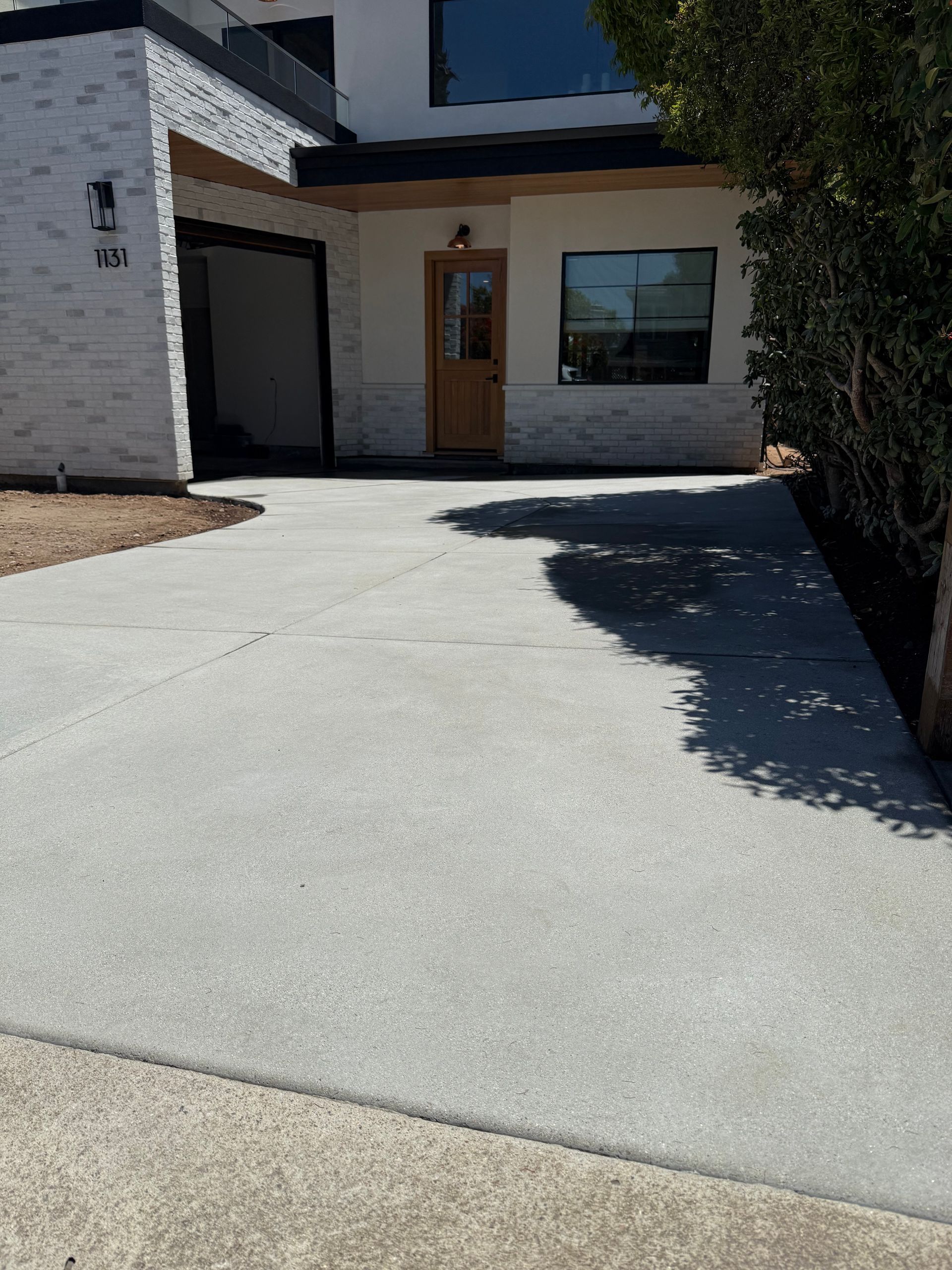
What Separates Durable Concrete From Surface-Level Work
Professional concrete installation includes subgrade moisture conditioning to prevent rapid water loss from fresh concrete into dry soil, which weakens the bottom portion of the slab and leads to premature cracking. Forms must be level and properly staked because concrete flows to find level, and any deviation in formwork creates sloped surfaces that collect water or create drainage problems. Reinforcement placement matters because steel positioned too low in the slab provides minimal crack control, while steel too close to the surface risks corrosion exposure when moisture penetrates the concrete over time.
After concrete cures and forms are stripped, you notice surfaces that remain level without settling, expansion joints that control cracking in predictable locations rather than random spiderweb patterns across slabs, and edges that don't spall or crumble under traffic. Decorative options including stamped patterns and integral color provide visual interest while maintaining the structural performance of standard flatwork. Properly finished concrete resists scaling in freeze-thaw climates, though San Diego's mild conditions reduce this concern compared to regions with harsher winters.
Concrete applications extend beyond basic flatwork to include foundation slabs for buildings and additions, equipment pads for HVAC units and generators, retaining wall footings, and structural elements that require coordination with engineering specifications. Each application follows specific mix design, reinforcement schedules, and finishing techniques appropriate to its function and load requirements.
What Homeowners Want to Know About Concrete Work
Property owners planning concrete installations typically ask about site preparation requirements, decorative options, and factors affecting long-term performance.
What site preparation is required before concrete placement?
Excavation removes organic material and unstable soil, grading establishes proper drainage slopes, base material is placed and compacted to create uniform subgrade support, and moisture conditioning prevents rapid water loss from fresh concrete into dry soil underneath.
How do control joints prevent random cracking?
Control joints are tooled or saw-cut grooves that create intentional weak points where thermal expansion and minor subgrade movement cause cracks to form in straight lines rather than wandering across the slab surface. Joint spacing follows guidelines based on slab thickness and concrete mix properties.
What decorative concrete options work for residential properties?
Stamped concrete replicates patterns like stone, brick, or tile through texture mats pressed into fresh concrete. Integral color mixes pigment throughout the concrete rather than surface-applied stains that wear away. Exposed aggregate finishes reveal decorative stone within the mix after surface mortar is washed away before final set.
When is thicker concrete necessary for driveways?
Standard residential driveways use four-inch thickness over properly compacted base, but heavier vehicles, poor soil conditions, or areas with frequent turning traffic benefit from thicker slabs with additional reinforcement to prevent cracking under concentrated loads.
How does San Diego's climate affect concrete installation and performance?
Low humidity and warm temperatures accelerate concrete curing, which requires attention to moisture retention during the critical early curing period. Minimal freeze-thaw cycles reduce scaling risks, but thermal expansion from daily temperature swings still necessitates proper joint spacing and placement.
Trueskil handles concrete installations for residential and commercial properties across the San Diego area with attention to site-specific conditions and long-term performance requirements. Schedule a consultation to discuss your concrete project scope, review decorative options, and evaluate site preparation needs.